
We Are Stanford Law
Research, Scholarship and News
With impact in everything from constitutional law and privacy rights to campaign finance reform and the environment, members of the Stanford Law School community shape law and policy through leading-edge research.



SLS Degree Programs
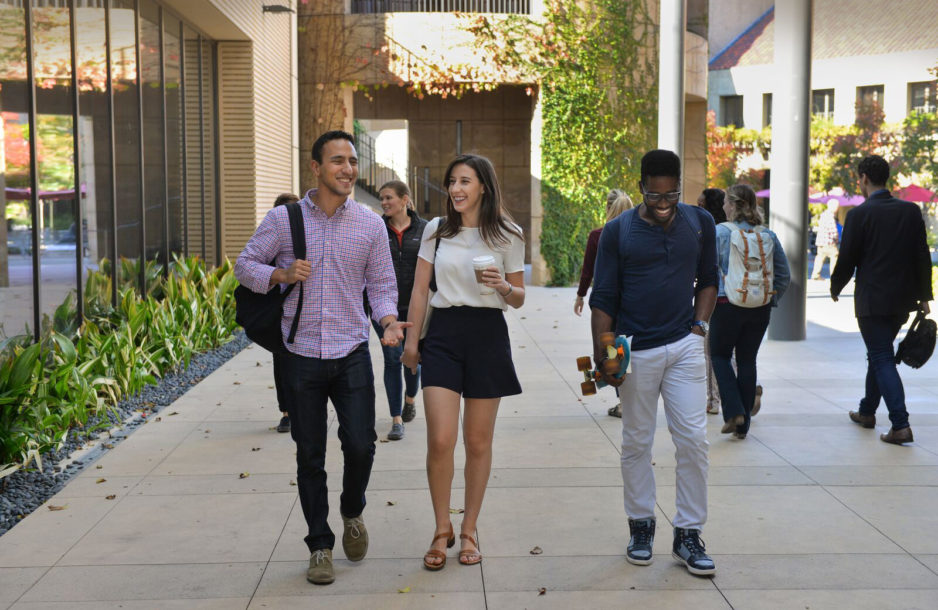

Join a diverse and inclusive community shaped by a commitment to the future.
Learn more : The JD Program
A hallmark of Stanford University and a distinct strength of Stanford Law, where students can explore the many ways law intersects with other fields.
Learn more : Joint Degree Programs
One-year master's degree programs and a doctoral degree (JSD) for international graduate students who have earned a law degree outside the United States.
Learn more : Advanced DegreesIn Focus





Spring Short Course | A Litigator's Guide to AI. Attention Is All You Need?
Stanford Law School “Short Courses" are intensive one- or two-unit offerings that run just a few weeks and bring distinguished judges, practitioners, and policymakers into the classroom.
Connect with Us



Through training, testing, and in-house innovation, Stanford Law’s Robert Crown Law Library is becoming a model for how law schools can employ AI and prepare future lawyers for a new era of practice.
Over the past two and a half years, the library team has built an AI framework that spans ...research guidance, tool testing, pedagogy, technical development, and training for students, faculty, and staff.
It also recently added two AI-focused librarians, roles Williams believes are the first of their kind in U.S. academic law libraries.
“Our librarians were experimenting with AI long before anyone asked them to,” says Beth Williams, the Robert Crown Law Library’s associate dean and a senior lecturer. “In fact, much of our AI infrastructure happened organically. People on the team saw where the future was headed and moved quickly in that direction.” Read more in #StanfordLawMag: https://brnw.ch/21x2qii
Tort reformers have long argued that contingency fees can put too much money in plaintiffs’ lawyers’ hands. A new article by Deborah L. Rhode Center researchers Nora Freeman Engstrom and Brianne Holland-Stergar asks a more basic question: Are contingency fees competitive at all?
Their ...answer: Not really.
In their recently published article, “Competition and Contingency Fees,” the authors reveal striking price uniformity, little public disclosure of fee information, and a market where clients cannot compare lawyers on price or performance.
They argue for greater transparency, including standardized “closing statements” that would show how contingency fee cases actually resolve, including what clients recover, what lawyers are paid, and how long cases take. The goal is to give clients better information, help policymakers regulate based on evidence, and make the market work more competitively.
Read the Q&A:

In a new article, Stanford Law Professor Nora Freeman Engstrom and University of Montana Professor Brianne Holland-Stergar tackle one of the longest-s
brnw.ch
At the recent CodeX LLM x Law Hackathon, the clock was ticking, whiteboards were filling up, and Stanford Law students Joshua Waldman, JD ’27, and Will Dinneen, JD ’28, were feverishly using AI to take copyright infringement search to the next level.
Created with teammates Chris Um of ...Cornell and Dhanin Wongpanich of UC Berkeley, the prize-winning tool they dubbed “Warhol” goes beyond “does an image look similar?” to ask whether it might raise a real infringement problem. Read more: https://brnw.ch/21x2jR8

The Stanford Law School Law & Policy Lab, Heterodox Academy, and the McCoy Family Center for Ethics in Society will co-sponsor a panel discussion on Monday May 11 from noon to 2 p.m. PT.
The panel will explore the Trump administration's efforts to impose conditions for federal ...funding and its use of other mechanisms to restrict academic freedom, particularly in the conduct of research.
RSVP: https://brnw.ch/21x2ic1