
We Are Stanford Law
Research, Scholarship and News
With impact in everything from constitutional law and privacy rights to campaign finance reform and the environment, members of the Stanford Law School community shape law and policy through leading-edge research.

SLS Degree Programs
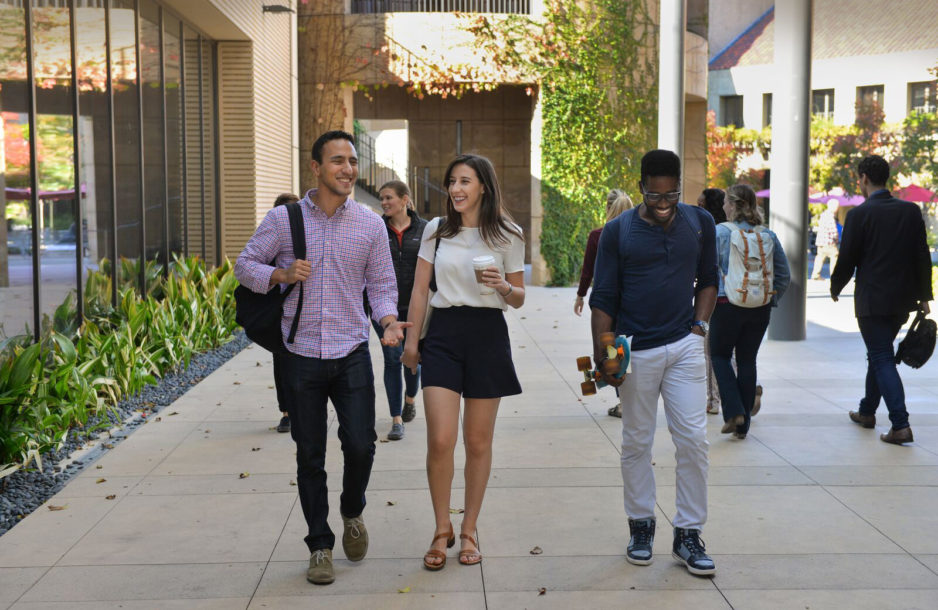

Join a diverse and inclusive community shaped by a commitment to the future.
Learn more : The JD Program
A hallmark of Stanford University and a distinct strength of Stanford Law, where students can explore the many ways law intersects with other fields.
Learn more : Joint Degree Programs
One-year master's degree programs and a doctoral degree (JSD) for international graduate students who have earned a law degree outside the United States.
Learn more : Advanced DegreesStanford Law Students Share Their Stories



2026 LLM x Law Hackathon
The hackathon wasn’t just a competition; it was a glimpse into what becomes possible when the people who understand AI and the people who understand law are finally in the same room, building together.

Connect with Us


What happens when legal expertise meets artificial intelligence?
In a recent 60 Minutes segment, Vorys, Sater, Seymour and Pease LLP highlighted its work with Stanford Law School’s liftlab to develop an internal AI tool built around the knowledge and judgment of senior lawyers.
The Read moretool does not replace attorneys. It helps lawyers prepare more effectively by offering feedback informed by the approaches, preferences and experience of Vorys partners. For trial lawyer Kim Herlihy, that can mean reviewing a draft opening statement and receiving feedback from an AI persona trained on her own professional insights.
As Herlihy noted, AI will not walk into a courtroom to deliver an opening statement. But it can provide another tool to help lawyers prepare for the work only people can do: counsel clients, exercise judgment and advocate before judges and juries.
Watch the full 60 Minutes segment: https://brnw.ch/21x6eL3
Visit liftlab's website: https://brnw.ch/21x6eL4



A closer look at Neukom Tower.

What does political freedom have to do with AI safety?
On Thursday, Oct. 8, from 5 to 6 p.m. PDT, the Rule of Law Speaker Series will feature “AI and Political Freedom,” a discussion with Matthew Botvinick, Anthropic’s lead on AI and the Rule of Law.
Botvinick will examine Read morewhy AI safety depends on the political freedom democracy secures — and how AI could place unprecedented pressure on democratic institutions.
The event is co-sponsored by the Neukom Center for the Rule of Law and the Stanford Law AI Initiative. His book, “AI and Political Freedom,” will be available for purchase at the event.
https://brnw.ch/21x6cJD
Permitting reform need not come at the expense of environmental protection or public participation.
In a new essay, Professor Deborah A. Sivas, JD ’87, co-director of the Environmental Law Clinic, examines federal permitting legislation and California’s Proposition 45. She argues that Read moreboth measures would make sweeping changes to cornerstone environmental laws, including NEPA and CEQA, while narrowing opportunities for communities to seek judicial review.
The path to faster, more equitable infrastructure and housing development, she writes, requires evidence-based reforms that build trust, transparency and shared benefits — not broad rollbacks of environmental safeguards.
Read the essay: https://brnw.ch/21x6bhp
#EnvironmentalLaw #NEPA #CEQA #PermittingReform #EnvironmentalJustice

The “Abundance” agenda took a major step forward last week when four U.S. Senators introduced the “Bipartisan American Affordability and Jobs Ac
brnw.ch