Legal Ethics Professor Norman Spaulding '97 Joins Law Faculty
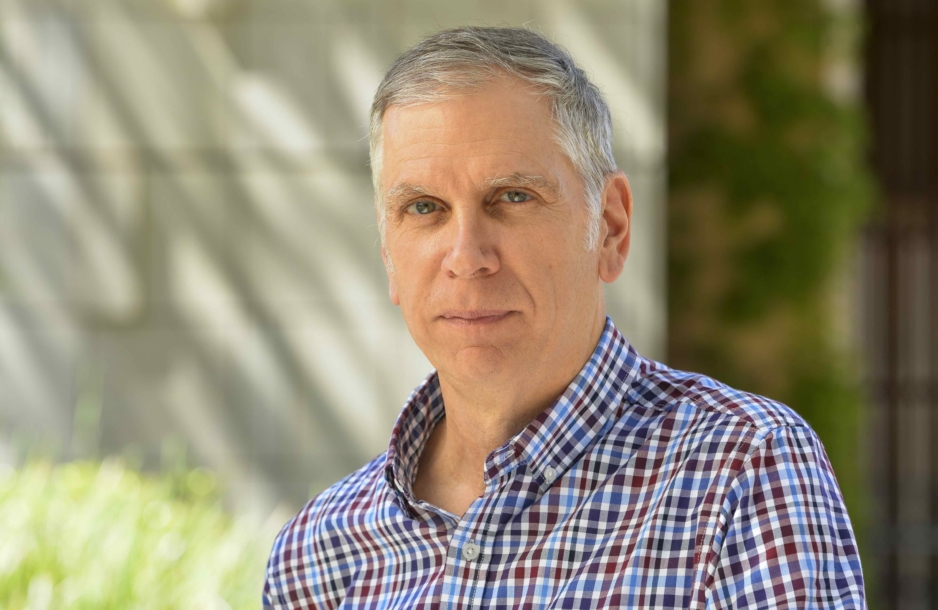
![]() Norman W. Spaulding '97, Professor of Law and John A. Wilson Distinguished Faculty Scholar. Photo: Steve Gladfelter |
Growing up in Berkeley, California, Norman W. Spaulding '97 couldn't help feeling a deep appreciation for the power of law. His African-American father and his white mother were married within a year of Loving v. Virginia, the landmark 1967 Supreme Court ruling that declared laws against interracial marriage unconstitutional. "It was incomprehensible to me, the idea that a state could have a law making it impossible for my mother and father to be married," the 34-year-old scholar recalls now, shaking his head. "Since then, I've always had this sense of how deep law can reach into society. It can reach into the family. It can reach into the bedroom. It can reach into marriages."
Spaulding, a nationally recognized scholar in legal ethics and the history of the profession, won rave reviews at Stanford last year for his performance as a visiting professor from the University of California at Berkeley School of Law (Boalt Hall). Now he hopes to build on that success in his new position at Stanford as a tenured professor of law and John A. Wilson Distinguished Faculty Scholar.
"I was quite happy at Berkeley," he said in a recent interview, "but the students I had here were easily the best group I've ever had the pleasure of teaching." Stanford's stimulating intellectual climate was attractive as well: "If there's one thing that really drove this decision home for me, it was the idea of getting to share work and grow as a scholar in this community."
As a Stanford law student in the mid-1990s, Spaulding served as an articles editor for the Stanford Law Review, a member editor for the Stanford Environmental Law Journal, and a member of the Black Law Students Association. After graduation, he practiced in the San Francisco office of Skadden, Arps, Slate, Meagher & Flom LLP, where he did environmental litigation. Spaulding then clerked for Judge Betty Fletcher of the U.S. Court of Appeals for the Ninth Circuit and for Judge Thelton Henderson of the U.S. District Court for the Northern District of California, before joining the Boalt faculty in 2000. Last year, the Association of American Law Schools presented him with its Outstanding Scholarly Paper Prize for an article he wrote for the Columbia Law Review, "Constitution as Counter-Monument: Federalism, Reconstruction and the Problem of Collective Memory."
Barbara Allen Babcock, Judge John Crown Professor of Law, Emerita, remembers Spaulding as a standout in her criminal procedure course at Stanford. "His outstanding quality was and is intellectual eagerness and thoughtfulness," she said. "He really loves the law and the study of law. That is what makes him a great teacher—his enthusiasm and passion are truly inimitable. It's just a terrific hire."
Much of Spaulding's scholarship focuses on when lawyers go wrong; he probes the causes of professional failure and malaise from a historical perspective. "We often hear the claim that the profession is in decline, that it's in crisis because lawyers have become too zealous and too client-centered," he said. "But that has never sat well with me." In fact, "when you look back at the historical record, you find that most of the problems that we take to be indicia of a crisis in the legal profession are not new. American lawyers have always wrestled with the tension between serving clients, making a living, and serving the communities in which they work." People will rightly be suspicious of lawyers and the power that they have in a society governed by law, he said. But at the same time, "they'll want a zealous advocate when their rights are on the table."
At Stanford, Spaulding will teach courses in professional responsibility, civil procedure, and remedies. He plans to continue pro bono work (he's representing a California prisoner) and is collaborating with Babcock to update her widely respected casebook, Civil Procedure: Cases and Problems. "You can't imagine my surprise that I'm back here. But it's wonderful and exciting, too. Everybody here does such exceptional work. It's a real inspiration just to be in the building."
—Theresa Johnston
Political Science Scholar Daniel Ho Brings Empirical Expertise to Stanford
![]() Daniel Ho, Assistant Professor of Law. Photo: Bob Narod |
The day in 1989 that the Berlin Wall fell, Daniel Ho was a 10-year-old living in Sandhausen, West Germany, with his parents. "There were celebrations all over Germany," he said. "It was very exciting. I remember being out on the street, throwing firecrackers."
That event, along with the experience of growing up in Germany during the Cold War, sparked in Ho a fervid interest in politics. His interest took him to the University of California, Berkeley, where he earned a bachelor's in political science, then to Harvard and Yale, where he earned, respectively, a PhD in political science and a JD.
Now it has taken him to Stanford Law School, where he will start as an assistant professor in the fall of 2006. Ho is spending this year clerking for Judge Stephen F. Williams of the U.S. Court of Appeals, District of Columbia Circuit.
Ho has made empirical research the focus of his studies. One product of his research was a series of articles on how ballot format affects voting. He and Kosuke Imai, assistant professor in the Department of Politics at Princeton, showed that roughly 3 percent of voters in California primary elections chose candidates simply because the candidates were listed at the top of the ballot. "Over 10 percent of primary races are won by margins that are smaller than such ballot effects," he noted.
Ho also examined UCLA School of Law professor Richard H. Sander's recent claim that affirmative action causes African-Americans to increasingly fail the bar. In the Yale Law Journal, Ho showed that Sander's analysis incorrectly controlled for law school grades. "The same student would generally earn worse grades in a higher tier law school," he said. For black students with similar qualifications upon law school admission, says Ho, there's no evidence that going to a higher tier law school will hurt their chance of passing the bar.
Ho says he is thrilled to be moving back to the Bay Area. "I'm excited to start teaching and doing research at Stanford. The university has an amazing faculty and student body."
—Mandy Erickson
William Koski (PhD '03) Named School's First Clinical Professor
![]() William Koski (PhD '03), Professor of Law (Teaching). Photo: Steve Gladfelter |
As an incoming University of Michigan freshman, William S. Koski (PhD '03) had never taken calculus, read the classics or even heard about AP classes. "These things simply weren't available at my high school" in Ishpeming, Michigan, a small town in the Upper Peninsula, said Koski. "And I wanted to do something to fix those inequalities."
His college experience of tutoring students in a juvenile detention center, some of whom couldn't read, only enhanced his desire to level the educational playing field. "Education is a civil right," he said. "If we believe that schooling is our society's mechanism for social mobility, we must recognize the need for reform." Koski, director of the Youth and Education Law Clinic, has promoted education rights through the clinic, which helps low-income children in Bay Area school districts. And now he has received his own promotion: this fall he became professor of law (teaching), making him the first clinical professor at the law school.
Koski attended the University of Michigan Law School right out of college, always intending to fight for the underdog. Following a stint with Orrick, Herrington & Sutcliffe LLP, in San Francisco, he earned a PhD at Stanford's School of Education while volunteering at the East Palo Alto Community Law Project. After teaching Stanford law students as a clinical instructor at the Law Project, Koski was hired by the law school as an associate professor (teaching) to launch the Youth and Education Law Clinic.
As director of the clinic, Koski teaches a class on law and education policy, supervises students representing clinic clients, and oversees complex school reform litigation. In addition, he and the students influence education policy at the state and local level through research and advocacy: some of the recommendations made by his clinic were incorporated into California's Senate Bill 1895, which provided for mental health services for disabled kids. It was passed in 2004.
"Schooling has such a deep and lasting impact on people," Koski said. "Everyone deserves a first-rate education."
—Mandy Erickson
Environmental Expert Margaret Caldwell '85 Promoted to Senior Lecturer
![]() Margaret "Meg" Caldwell '85, Senior Lecturer in Law and Director, Environmental and Natural Resources Law and Policy Program; Senior Lecturer, Stanford Institute for the Environment. Photo: Joe Neto |
Margaret "Meg" Caldwell '85, who came of age with the ecology movement, was forever imprinted with a lasting desire to fight for the environment. "I grew up in the '60s," explained Caldwell, the director of the Environmental and Natural Resources Law & Policy Program at Stanford Law School. "That was the awakening of environmentalism. I decided in the sixth grade that I wanted to be an environmental lawyer, and I never wavered in my goal."
Not only did Caldwell become an environmental lawyer, but she now chairs one of the most powerful land use agencies in the nation, the California Coastal Commission, which has broad powers to regulate California's coastline. This fall Caldwell was promoted to the position of senior lecturer at Stanford Law School. Caldwell started her career with Bingham McCutchen LLP in San Francisco, where she represented land owners in cleaning up superfund sites. She later joined the City of Saratoga (California) Planning Commission. "That's where I cut my teeth on land use issues," she said.
Since joining the law school in 1994, Caldwell has spent much of her time compiling a collection of business-school-style case studies of environmental and natural resources law. Teaching with case studies, Caldwell said, is a more effective teaching tool: "It allows students to discover the law for themselves and learn how to become problem solvers."
—Mandy Erickson
International Law Scholar Helen Stacy Promoted To Senior Lecturer
![]() Helen Stacy, Senior Lecturer in Law. Photo: Steve Gladfelter |
In the late 1980s, Helen Stacy was a barrister in London, struggling to prosecute defendants being carted from jail to jail. Initially sent from her native Australia to extradite an alleged drug trafficker for trial, Stacy noted the differences between standards in the Australian, British, and European legal systems.
Later, as a professor in the Faculty of Law at Queensland University of Technology in Brisbane, she researched the differences between legal systems, receiving a scholarship to study in Germany and teaching in Indonesia and South Africa. "It's fascinating to watch the centripetal pull on one country's legal performance because of standards in neighboring countries," she said.
Stacy has brought this fascination to Stanford, where she has taught international human rights and international jurisprudence at the law school. Her promotion this year to senior lecturer at the law school gives her a stronger platform from which to teach. Part of Stacy's work is comparing the efforts of Romania, Mexico, and Thailand in improving their court systems and their policing.
Stacy is also studying the problem of applying international standards to different cultures in a book she is writing, Human Rights and Globalization (Stanford University Press, 2006). "I am making the argument that regional courts like the European, Inter-American, and African systems, and hopefully one day also, an Asian system are a linchpin to better human rights," Stacy said.
—Mandy Erickson